FMCSA Motus Explained: What Changed for Carriers and Brokers in 2026
Updated Oct 22, 2026 · General information, not legal advice. Confirm requirements on the official FMCSA source.
FMCSA Motus is the USDOT Registration System that took over the registration functions of several older FMCSA systems in May 2026. Carriers use it to keep their company information current and to file updates such as the MCS-150 biennial update. Brokers can search its public records for current authority and insurance filings, then use SAFER for the carrier’s safety record.
What is FMCSA Motus?
Motus is the Federal Motor Carrier Safety Administration’s online registration system at motus.dot.gov ↗. It brings applications and company record updates together in one company account. Motus changed where companies register, not what they need to register for: the required registrations still depend on the work a company does. Opening a Motus account is not the same as holding the registration your operation needs. (FMCSA Motus guidance) ↗
Motor carriers, brokers, freight forwarders, intermodal equipment providers, and cargo tank facilities register and keep their records in Motus. Account holders can also file biennial updates and track the status of their registration actions. Looking up a carrier is simpler: the public search needs no login, so a broker can read a company’s record without any access to its account.
An existing business claims its record through a company official, who then controls which users can make changes. Shippers, brokers, and other members of the public can read the published registration information without an account.
Why FMCSA moved registration work to Motus
Before Motus, registration work was split across three systems: the Unified Registration System (URS), Licensing & Insurance (L&I), and the registration options in the FMCSA Portal. Motus now handles all of it, so older instructions that send you to one of those systems may describe a process that has moved. URS closed for good, L&I still shows historical records, and the Portal stayed online for its other functions; only its registration options moved. (FMCSA transition bulletin) ↗
FMCSA also built stronger identity verification and fraud checks into Motus, and in March 2026 it warned that USDOT and MC numbers may not be sold, bought, or leased outside a legitimate corporate transaction. For a broker, a lookup shows what the record says about a company. It cannot tell you whether the person offering to haul your load actually works for that company; an active registration alone does not answer that question. (FMCSA registration changes) ↗ (FMCSA bulletin) ↗
Account holders sign in with Login.gov and complete identity verification. To claim an existing USDOT record, FMCSA tells the company official to use the same Login.gov email they used as company official in the FMCSA Portal. Once you have access, review who can act for the company, including any outside filing service, and keep control of those permissions inside the company. (FMCSA Motus guidance) ↗
Motus launch and transition timeline
FMCSA rolled out the change in stages. The old systems stopped taking registration actions a few days before Motus opened to everyone:
| Date | What FMCSA announced | Practical meaning |
|---|---|---|
| December 2025 | Supporting companies got limited early access | BOC-3 filers, insurance and surety filers, and transportation service providers could set up accounts before the public launch. |
| May 14, 2026, 8 p.m. ET | Legacy registration actions began shutting down | Registration options in the Portal, URS, and L&I went offline for good, and no filings could be submitted during the switch. |
| May 19, 2026 | Motus launched for general users | New and existing registrants could create profiles. FMCSA directs all filing and record activity after May 18 to Motus. |
| September 10, 2026 | FMCSA last updated its temporary biennial-update notice | FMCSA paused enforcement and USDOT inactivation for biennial updates due on or after June 1, 2026. |
FMCSA’s account FAQ confirms these dates. (FMCSA account FAQ) ↗ Before starting a filing, check current registration alerts ↗ for instructions that may have changed since the launch.
What changed for motor carriers
Registration, account access, and Login.gov
Create the company official’s personal profile and complete identity verification, then claim or create the company account. The personal profile identifies the user; the company account links authorized users to the registrations they can manage.
FMCSA says an official can claim an existing USDOT record and import the company data. Review that information before certifying it, particularly details that have changed since an earlier filing. Staff and service providers should receive the access their work requires through the account process. Sharing the official’s password makes it harder to keep control of filings and is no substitute for authorized access.
MCS-150 and other registration changes
Motus handles biennial updates, company name and address changes, and USDOT status actions such as inactivation and reactivation. The MCS-150 keeps a motor carrier’s USDOT record current, and its regular schedule follows the last two digits of the USDOT number. As of October 22, 2026, FMCSA has paused enforcement and USDOT inactivation for biennial updates due on or after June 1, 2026, and is giving registrants extra time. The filing requirement itself remains. (FMCSA transition notice) ↗
If an older FMCSA page sends you to Portal menus, begin with the Move into Motus instructions ↗. In the company account, the Motus job aid names “Biennial Update Information” and its “Start” button as the way to begin an update. (FMCSA Motus job aid) ↗ Our MCS-150 biennial update guide explains how the regular schedule works alongside the temporary pause.
What changed for brokers checking carriers
Brokers can use the public search without signing in. Enter an exact USDOT number or the beginning of the company’s legal or DBA name, then open the matching company. Expand “Operating Authority Registration(s)” and select the relevant authority type to see its status and insurance details. (FMCSA public search) ↗
An insurance filing is not the full policy, and it does not prove coverage for the freight you plan to move. Get the certificate and, where the load calls for it, confirm the commodity, route, and vehicle with the insurer.
Suppose a carrier packet has a valid USDOT number but the dispatch email is unfamiliar. The number leads you to the real company, not to proof that the sender works there. Confirm that through a known company contact, and resolve any mismatch among the packet, the public record, and the named insured before booking.
FMCSA directs users to Motus for any filing or carrier record activity after May 18, 2026. SAFER still provides the safety snapshot, while a registration file downloaded earlier may describe the company as it was at that time. (FMCSA filing guidance) ↗ Our SAFER vs Motus comparison shows which source to use for each field and how to handle conflicting results.
Is SAFER still accurate?
Yes, for what it is built to show. The SAFER Company Snapshot covers the safety rating (if any), roadside inspection summaries, and crash counts. Its FAQ says snapshot data is updated daily, while inspection and crash counts are updated weekly. SAFER also shows USDOT and operating authority status, and its Licensing & Insurance links now open the company’s Motus record. Each snapshot states the date its data reflects: the one we checked on October 22, 2026, was current as of October 20. (SAFER FAQ) ↗
Be careful with the claim that SAFER “froze” on May 14. FMCSA’s May 12 notice described a temporary freeze of registration data during the switch and said SAFER would receive registration updates once Motus launched. What did stop on May 14 are some downloadable registration files, which still carry that cutoff. For a same-day registration decision, check Motus, and note the date of any older dataset you compare it with. (FMCSA transition bulletin) ↗
HaulerCheck reports show the source and date under every authority and insurance field. Where FMCSA has published a Motus record for a docket, we use the daily Motus files. Otherwise the report shows FMCSA’s records as of May 14, 2026; because FMCSA publishes every authority and insurance change since that date in Motus, a docket with no Motus record has not changed since then. Neither is a live check, so follow the report’s Motus link before booking. Our data sources and freshness page explains each source.
How to look up a company in Motus
- Open FMCSA’s Motus public search ↗ and confirm the hostname is motus.dot.gov ↗.
- Enter the complete USDOT number or the beginning of the legal or DBA name. A USDOT search requires an exact number; a name search works from the start of the name.
- Open the matching company record. Compare the registered name and USDOT number with the carrier’s packet, rate confirmation, and contact information.
- Expand “Operating Authority Registration(s).” Select the authority type to open its detail page and read “Current Status” together with “Status Reason.”
- Open the “Insurance Details” tab and read each filing’s status, effective date, and any cancellation date. Obtain any separate certificate or insurer confirmation needed for the load.
- Record when you checked the data. If the result conflicts with SAFER, a carrier packet, or a third-party lookup, rely on the official current registration record for registration questions and ask FMCSA or the carrier to resolve an unexplained mismatch.
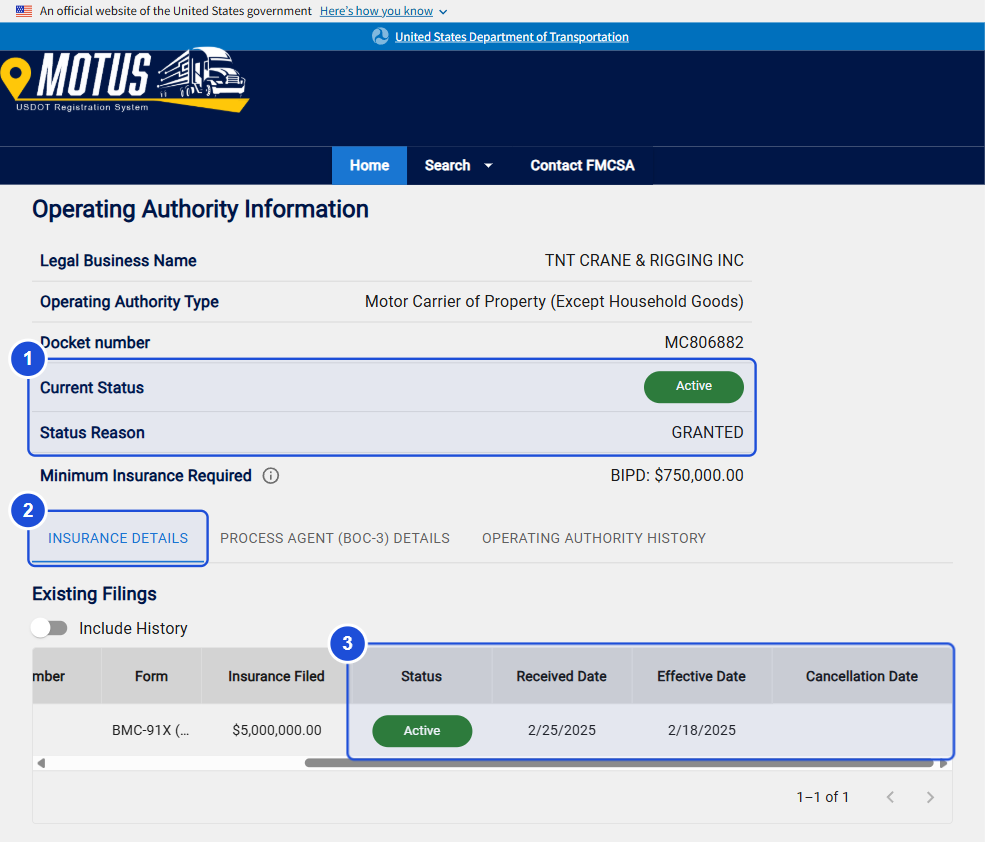
For example, the Motus record for TNT Crane & Rigging (USDOT 1843980) lists one authority: Motor Carrier of Property (Except Household Goods), docket MC806882, with Current Status “Active.” Its detail page gives the status reason “GRANTED,” a $750,000 minimum insurance requirement, and, under Insurance Details, a $5,000,000 BMC-91X liability filing effective February 18, 2025. (Motus record for USDOT 1843980) ↗
Next, open the SAFER Company Snapshot ↗ for the safety review. You can also look up a carrier on HaulerCheck by DOT or MC number, phone number, company name, or city and follow the report’s official links. The TNT Crane & Rigging sample report shows how a report separates these sections and labels their sources, and the state directory helps if you are starting with a location.
Common problems during the Motus transition
FMCSA’s transition notice acknowledges ongoing recovery and stabilization work in Motus. If a USDOT claim fails or a filing looks incomplete, contact the Registration Customer Service Center at 1-800-832-5660 or use the agency’s support webform. Keep the case number and follow up on that case: FMCSA asks users not to open duplicate tickets for the same issue. (FMCSA transition notice) ↗
One known problem: if a carrier’s email address was registered for the Transportation Service Provider (TSP) role by mistake, it cannot be used to claim the carrier’s USDOT record. FMCSA’s resources hub explains how to close the TSP account. (FMCSA resources hub) ↗
Before repeating a filing, compare the account’s confirmation with the public record. If the account shows a completed action but the public record has not changed, ask FMCSA about the existing case rather than filing again. For a broker, a docket that turns up under an unexpected company calls for the same care: match the USDOT number, name, and authority record before deciding which result applies.
When you contact FMCSA, give the USDOT number and the action you tried, and say whether the problem is signing in, claiming the company, a pending application, or a mismatch in the public data. A sign-in problem says nothing about whether FMCSA has granted an authority application.
What Motus does not tell you
The public record cannot confirm that a dispatcher or email sender is authorized to speak for a carrier, or that the truck arriving at pickup belongs to the business you checked. Review the company’s identity as well as its registration before accepting the load.
Call a number already on the official record to confirm an unfamiliar dispatch contact, load instruction, or payment change. The legal identity should match across the government record, insurance certificate, and transaction documents. For high-value freight, finish your onboarding and cargo-security steps even after the registration checks.
Frequently asked questions
Is Motus the same as a USDOT number?
No. Motus is the system used to manage registrations. The USDOT number identifies the regulated entity whose record you are viewing.
Is Motus login the same as Motus public search?
The public search lets you review registration records without signing in. A Motus login is for users authorized to manage a company’s registrations.
Can brokers check a carrier’s insurance in Motus?
Yes, where the public record includes the company’s insurance filings. You will still need the appropriate certificate or insurer confirmation to establish coverage for a particular shipment.
Should I still use SAFER?
Yes. Use SAFER for the Company Snapshot and safety information. Use Motus for current registration questions, checking source dates when the records differ.
Did Motus change existing USDOT or MC numbers?
No. Existing USDOT and docket numbers stay the same. New numbers issued in Motus are randomized, and each newly granted authority gets its own docket, while existing authorities keep sharing theirs. Because new numbers are random, a number’s size no longer shows how new a company is; check the authority type, status, and dates instead. (FMCSA registration changes) ↗
Does Motus replace the FMCSA Portal and URS?
Motus took over their registration work. URS was retired; the Portal remained available for other functions. Start with FMCSA’s current instructions for the action you need.
Official sources
Checked October 22, 2026.
- FMCSA: Motus USDOT Registration System ↗
- FMCSA: Move into Motus ↗ — Updated May 18, 2026.
- FMCSA: About FMCSA Registration Changes ↗
- FMCSA: When can I create my user profile and company account ↗ — Updated May 22, 2026.
- FMCSA: Transition to Motus Begins May 14 ↗ — Issued May 12, 2026.
- FMCSA: What can I do in Motus ↗ — Updated May 21, 2026.
- FMCSA: Temporary Suspension of the Biennial Update Requirement ↗ — Updated September 10, 2026.
- FMCSA: Navigating Your Company Account in Motus ↗ — May 2026 job aid.
- FMCSA: Registration Modernization Resources Hub ↗
- FMCSA: Motus public company search ↗
- FMCSA: Motus public record for USDOT 1843980 ↗
- FMCSA: SAFER Web Frequently Asked Questions ↗
- FMCSA: Company Safety Records ↗ — Updated June 23, 2023.
- FMCSA: Do Not Sell Purchase or Lease a USDOT or MC Number ↗ — Issued March 19, 2026.