How to Get an MC Number in 2026: Step by Step in FMCSA’s Motus
Updated Oct 30, 2026 · General information, not legal advice. Confirm requirements on the official FMCSA source.
To get an MC number in 2026, apply for the right operating authority in FMCSA’s Motus system and pay $300 for each authority type. The docket number is not permission to haul: FMCSA reviews the application, and your insurer and process agent must file the required financial responsibility and BOC-3 forms. You cannot take a load that needs the authority until it is active.
For a new trucking business, the hard part is keeping these steps moving together. A correct application can stay pending while you wait for an insurer or a process agent to file. Here is what to prepare, what Motus shows, and what to check before your first load.
First, know the difference between your USDOT number and operating authority
FMCSA uses your USDOT number to identify your business in its registration and safety records. An MC number identifies an operating-authority docket. An active USDOT record does not mean the company has active operating authority.
You generally need operating authority to haul federally regulated property for hire in interstate commerce. Passenger transportation for hire has its own authority types and exceptions. Choose the authority that matches what your company will actually do.
FMCSA does not require authority from private carriers hauling their own goods, carriers hauling only exempt commodities, or carriers operating only within qualifying commercial zones. “Local delivery” is not an automatic exemption: a trip inside one state can still be interstate commerce, and intrastate work may need state authority. Check the commodity and commercial-zone rules before you pay the nonrefundable fee.
Carrier authority does not let you act as a broker. A broker arranges transportation and needs its own authority; if your business will do both, check the registration and financial responsibility each role needs.
What to have ready before you apply
Gather the following before you start, and keep your business details identical everywhere so the insurer and process agent can match their filings to your application.
- Legal identity: the legal name, any DBA names, the business structure and owners, the physical address, and tax details such as your EIN.
- Registration history: any USDOT number and dockets you already have. A company that is already registered claims its record instead of creating a new one.
- Operation: the cargo, service area, vehicles, drivers, and the authority type you need.
- Account access: a Login.gov account and the information Motus needs to verify your identity.
- Insurance: a quote for your actual operation with the required coverage, from an insurer that can make the FMCSA filing.
- Process agent: a provider that will file your BOC-3 designation with the same company details.
Budget separately for insurance, state registrations, and operating costs: the government application fee is only one of the startup costs.
Apply through Motus, step by step
FMCSA closed its legacy registration systems on May 14, 2026, and Motus opened to all users on May 19. Older instructions that send new applicants to URS are out of date. Our FMCSA Motus guide explains what changed.
1. Set up your user profile
Open Motus ↗ directly or through FMCSA’s registration pages. Sign in with Login.gov, follow the new-registration steps, and complete your profile and identity verification. Keep control of your own credentials rather than leaving a filing service as the only party with access to your company account.
2. Create or claim your company account
A new business creates a company account; a company already registered with FMCSA claims its existing record. Do not assume the migration fixed old addresses or operating details: check the imported information carefully.
FMCSA’s Move into Motus ↗ page explains how to set up a user profile, create or claim a company account, and add or manage registrations. Creating the account does not complete your authority application.
3. Complete the application
Complete the application, check the details and certifications, and pay the fee. Registration types are added in the Registrations area of the company account. Pick only the types you need: each authority has its own requirements.
Keep the submission confirmation, the payment receipt, and the numbers you are assigned. Give your insurer and process agent the exact legal name and docket so their filings reach the right record.
4. Track the application and clear pending items
The company account shows Applications, with progress and needed actions, and Operating Authority Registration(s), with each authority’s status, pending reasons, and related filings. FMCSA’s company account job aid ↗ explains these sections.
Watch for FMCSA requests and contact whoever is responsible for a missing filing. Before you accept a load that needs the authority, confirm in Motus that it is active and keep a copy of the authority documents.
How Motus assigns MC and USDOT numbers
Motus assigns new USDOT and docket numbers at random, so the size of a number no longer shows how long a company has been in business.
When one application requests several authority types, each new authority gets its own docket. Existing numbers do not change, including older dockets that cover more than one authority type, and the MC, FF, and MX prefixes are still used.
Motus search results show letters after the USDOT number for the registration types on the record, as in 1843980(CV): C stands for a property carrier, B for a broker, F for a freight forwarder, and P for a passenger carrier. The letters are not part of the number, do not need to appear on your vehicles, and do not prove that an authority is active.
Fees and approval time
As of October 2026, FMCSA charges $300 for each operating-authority type. There is no federal fee for a USDOT number. The $300 is not refunded, even if you choose the wrong authority. Insurance premiums, process agent charges, and filing services cost extra.
FMCSA has not published a general Motus approval time as of October 2026. Some older FMCSA pages still give processing estimates from the previous system; they are not a Motus guarantee.
Under 49 CFR Part 365 ↗, protests must generally be filed within 10 days after the application is published in the FMCSA Register. That does not mean your authority becomes active on day 11: protests, missing information, outstanding filings, and FMCSA review all affect the timing.
The filings have a deadline too. According to FMCSA’s insurance filing requirements ↗, if they are not received within 20 days after publication, FMCSA serves a decision that the application will be dismissed unless you comply within 60 days. Treat that as a deadline, not as a reason to wait on coverage.
What the three Pending reasons in Motus mean
“Pending” means the authority has not been granted yet. Motus shows the reason, so you know whom to follow up with.
| Motus Pending reason | What to do next |
|---|---|
| Pending - FMCSA Review | Read your application messages and answer FMCSA’s requests. If you are unsure what is needed, contact FMCSA about the existing application instead of starting a duplicate. |
| Pending - Process Agent (Form BOC-3) Filings | Ask your process agent to file or correct the BOC-3. Check the legal name and docket, then confirm the filing appears in Motus. |
| Pending - Financial Responsibility Filings | Ask your insurer, surety, or other authorized provider to file the required evidence with the right coverage and effective date. An insurance certificate emailed to you does not replace the federal filing. |
Clearing one pending item does not mean the authority is approved. After a provider confirms a filing, check the authority status in Motus again.
Insurance and BOC-3 are separate requirements
Financial responsibility
Your insurer, or another authorized financial responsibility provider, files the evidence with FMCSA. For motor carrier liability insurance that is usually Form BMC-91 or BMC-91X. Buying a policy without the federal filing does not complete the authority process.
For for-hire carriers of nonhazardous property, 49 CFR 387.303T ↗ generally requires at least $750,000 of public liability coverage for vehicles with a gross vehicle weight rating of 10,001 pounds or more, and $300,000 when every vehicle is under 10,001 pounds. Hazardous materials and passenger operations have other minimums, and customers may ask for higher limits.
Broker authority generally requires $75,000 of financial security through a BMC-84 surety bond or a BMC-85 trust fund agreement. The $75,000 is the amount of security, not the price of the bond. Check FMCSA’s insurance filing requirements for the authority you need, including the cargo filing rules for household goods.
Process agent designation
Form BOC-3 names the process agents who can accept legal papers for your business. It is not insurance and not permission to operate. For a carrier, the process agent files the form. Our BOC-3 filing guide explains coverage, how to check the filing, and the limited self-filing option for brokers and freight forwarders without commercial motor vehicles.
Once your authority is active, keep it that way
Approval is the beginning. Keep the insurance and process agent filings in place, the company information accurate, and the driver, vehicle, and safety records you need.
- New Entrant Safety Assurance Program ↗: a new interstate motor carrier enters an 18-month monitoring period. For property carriers, FMCSA generally conducts the safety audit within 12 months of the start of operations, so keep compliant records from day one.
- MCS-150: keep your operating information current. FMCSA has temporarily suspended enforcement and USDOT inactivation for missed biennial updates due on or after June 1, 2026, but the update requirement has not gone away; see our MCS-150 guide.
- UCR: check your annual obligation. The lowest bracket costs $55 for 2027, up from $46, and larger fleets pay more. Our UCR registration guide explains who pays and which vehicles count.
- State and vehicle programs: you may also need IRP apportioned registration, an IFTA fuel-tax license and returns, and state registrations. Federal authority does not replace them.
Check the record brokers will see
Look up your company on HaulerCheck and compare its name, contact details, authority, and filings with Motus. Our MC number lookup guide explains how to read the record and its identifiers.
While your application is pending, the report shows a red “High risk: resolve before booking” warning with the signal “Operating authority is pending.” That is normal during an application: until the authority is granted, the company cannot haul interstate freight for hire that requires it. Once Motus shows the authority as active, the signal goes away with our next daily data update.
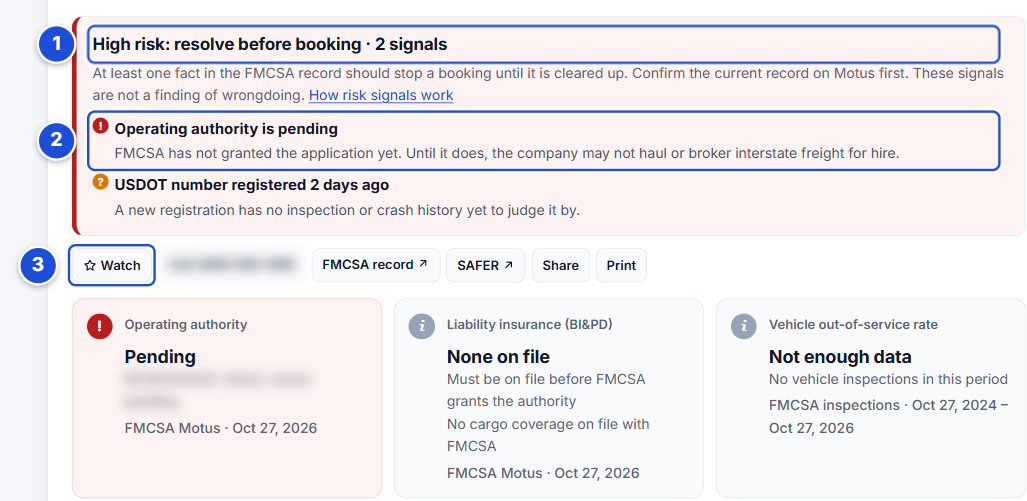
This is HaulerCheck’s own risk classification, not an FMCSA finding of fraud. The separate signal “No BOC-3 process agent on file,” for an active docket without a BOC-3, is a review-level signal. Our risk signals page explains the difference.
Press Watch on your report to follow changes. The free plan includes email alerts for 5 companies: when a watched company’s authority, insurance, name, phone, or address changes, HaulerCheck sends one email that day listing the changes, and none on days without changes. An alert is not permission to haul. Public records can lag, so use the report’s “FMCSA record” link to confirm the official record, and see how current our data is.
Do not buy or lease an MC number
FMCSA warns ↗ against selling, buying, or leasing a USDOT number or operating authority outside of a legitimate corporate transaction, and says it will start proceedings to inactivate the number and revoke the related registrations when it finds such a deal. An “aged MC” offer is not a shortcut around registration or safety review. Leasing equipment under the federal leasing rules is allowed and is a different thing from using another company’s registration.
Frequently asked questions
I have a USDOT number. How do I get an MC number?
Claim your existing company record in Motus, then add the authority you need. Do not get a second USDOT number just to add authority.
How long does it take to get an MC number?
Getting the number and getting the authority approved are different steps. FMCSA still has to review the application and receive the required filings, and it has not published a general Motus approval time.
Can I haul while my authority is pending?
Not for transportation that requires that authority. An application, a payment receipt, or an assigned MC number does not change that.
Can I get a refund for my MC number application?
No. The $300 fee per authority type is nonrefundable, so choose the right type before you pay.
Does active authority mean I passed the new entrant audit?
No. Authority activation and the New Entrant Safety Assurance Program ↗ are separate. Keep the required records and take part in the audit and monitoring.
This is general information, not legal advice. Check FMCSA’s official sources for the requirements that apply to your operation.
Official sources
Checked October 25–28, 2026.
- FMCSA: Move into Motus ↗, Changes to FMCSA Registrations in Motus ↗, and Navigating Your Company Account in Motus ↗.
- FMCSA: Get Operating Authority ↗ — fees; updated April 20, 2026, before Motus, so its application steps are out of date.
- FMCSA: Insurance Filing Requirements ↗ and New Entrant Safety Assurance Program ↗.
- eCFR: 49 CFR Part 365 ↗ and 49 CFR 387.303T ↗.
- FMCSA: Temporary Suspension of the Biennial Update Requirement ↗.
- FMCSA: Do Not Sell, Purchase, or Lease a USDOT or MC Number ↗ — issued March 19, 2026.
- FMCSA: Registration Video Library ↗ — Motus training videos.