UCR Registration for 2027: Who Needs It, Fees, and How to Register
Updated Oct 29, 2026 · General information, not legal advice. Confirm requirements on the official FMCSA source.
UCR registration is an annual registration and fee for covered interstate carriers, brokers, freight forwarders, and leasing companies. Fees for 2027 range from $55 to $54,165, depending on the type of business and the number of vehicles. Registration for 2027 is open at ucr.gov ↗, and a business that will keep operating must register and pay before January 1, 2027.
Who needs Unified Carrier Registration
UCR covers interstate for-hire carriers of property and passengers, motor private carriers of property, brokers, freight forwarders, and companies that lease vehicles to covered interstate operators. A private carrier hauling its own goods may not need the operating authority that for-hire freight requires, but it can still owe UCR.
Brokers must register even though they do not operate trucks. Leasing companies register in their own category. A freight forwarder that operates vehicles pays by its fleet bracket; one that operates none ordinarily pays the lowest bracket.
Interstate freight can stay inside one state
Take a truck that carries imported goods from a port to a warehouse in the same state. That leg can still be part of interstate or foreign commerce, because what counts is the whole movement of the shipment from origin to final destination, not only the truck’s route. The UCR eligibility questionnaire ↗ asks about movement before pickup and after delivery for this reason.
A business that moves goods or passengers only within one state is generally outside UCR, but only when the commerce is truly intrastate. Private carriers of passengers, such as a company that transports its own employees, do not register, and there are specific exclusions for emergency and government operations. An interstate property carrier is not removed from UCR because it works in a commercial zone or hauls an exempt commodity.
A smaller vehicle does not take you out of UCR either. A for-hire carrier or freight forwarder with a federal MC number must register even when none of its vehicles meets UCR’s commercial motor vehicle definition, and it ordinarily pays the lowest bracket. If your business falls into more than one category, use the official questionnaire and confirm with your base-state UCR agency.
The complete 2027 UCR fee table
We checked these annual fees on October 25, 2026. 49 CFR Part 367 ↗ keeps the 2025–2026 schedule in section 367.40 and the schedule for 2027 and later in section 367.50.
| Bracket | Countable commercial vehicles | 2025–2026 fee | 2027 fee |
|---|---|---|---|
| B1 | 0–2 | $46 | $55 |
| B2 | 3–5 | $138 | $167 |
| B3 | 6–20 | $276 | $333 |
| B4 | 21–100 | $963 | $1,163 |
| B5 | 101–1,000 | $4,592 | $5,548 |
| B6 | 1,001 or more | $44,836 | $54,165 |
Brokers and leasing companies pay the B1 fee, $55 for 2027. The fee is per business, not per truck: a carrier with 4 countable vehicles owes $167, not 4 × $167.
The September 1, 2026 final rule ↗ took effect on October 1, 2026 and raised every bracket by about 20%. The smallest bracket rose by $9, or about 19.6%. Use the dollar table rather than adding 20% to last year’s payment.
Which vehicles count
UCR counts self-propelled commercial motor vehicles that meet its weight, passenger, or hazardous materials criteria: a gross vehicle or combination weight of 10,001 pounds or more, a design to carry more than 10 people including the driver, or placardable hazardous materials. Trailers are not counted on their own, but a combination weight can make the towing vehicle countable.
The UCR Handbook ↗ counts the qualifying vehicles a business owns and uses, plus those it operates under long-term leases. Keep the vehicle and lease records that support your count.
The count usually comes from one of two bases: the most recent MCS-150 the business filed with FMCSA, or the vehicles it operated during the 12 months ending June 30 before the registration year. For 2027, that period ended June 30, 2026. A new business uses the fleet information its registration asks for; not having operated last year does not justify a smaller count.
Property vehicles used only in intrastate transportation may be deducted under the applicable rules. UCR’s vehicle-list instructions ↗ require supporting records and do not allow vehicles with apportioned IRP plates in that deduction. A truck that moves interstate freight does not qualify just because it stays in one state, and the deduction does not apply to passenger vehicles.
The MCS-150 suspension changes what you declare
Because FMCSA has suspended the required biennial MCS-150 updates, the UCR registration site asks every motor carrier to declare all commercial motor vehicles it operates in interstate commerce when it registers. Check the count you enter: an old federal filing may not describe today’s fleet. If the declaration the site asks for and the counting basis you use give different numbers, ask your base-state agency before you certify.
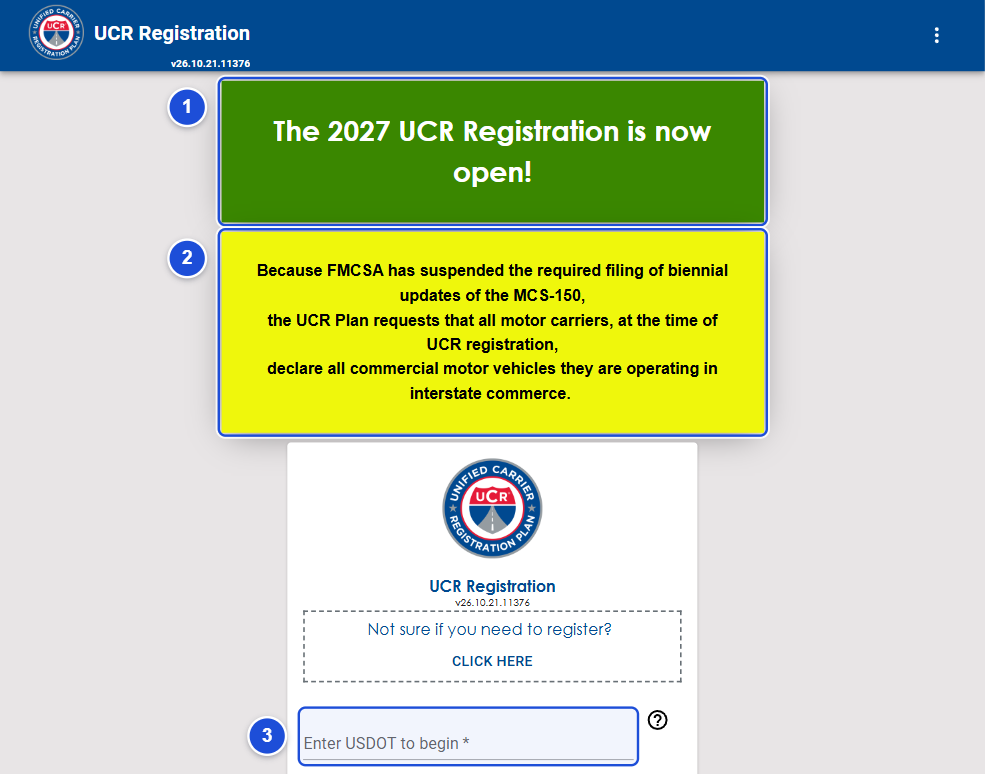
FMCSA’s temporary suspension notice ↗, checked on October 25, 2026, gives registrants more time for biennial updates due on or after June 1, 2026 and suspends the related enforcement and USDOT inactivation. The update requirement itself is not repealed. Our MCS-150 biennial update guide explains the difference.
How to register or renew on the official site
Have your USDOT number, company details, the registration year, your vehicle records, and a payment method ready. Even if someone else filed last year, start a renewal by checking the business and fleet details.
- Go to the official UCR registration site ↗. The first screen asks for a USDOT number and links the site’s terms and privacy policy.
- Read those notices and continue with your company’s record. Check the legal name and address before you enter anything else.
- Choose the registration year. A 2027 payment does not settle an unpaid 2026 obligation.
- Check the business classification, base state, and vehicle declaration, and resolve any mismatch before you certify. Keep the records that support any fleet adjustment.
- Confirm the fee for that year and bracket, complete the certification, and pay with a method the site offers.
- Keep the receipt and check that the registration and payment for the right year are recorded. Starting a form is not the same as registering.
A covered business based in a state that does not take part in UCR still owes it and chooses a base state under the Plan’s rules. The fee is annual and is not reduced for part of a year.
If you use automatic renewal, check what it is based on and the payment authorization before it runs. The October 2026 UCR newsletter ↗ says automatic 2027 registrations are done under option A, with the number of power units on the carrier’s most recent MCS-150. Compare that number with your current fleet before you rely on it.
The 2027 deadline and enforcement
According to UCR’s fee page ↗, a covered business must complete its registration and pay its fee before January 1 of the registration year: for 2027, by December 31, 2026. After that date the fee is still due, states can enforce, and the sources we checked describe no general grace period.
Penalties depend on the law of the state that enforces, so there is no single nationwide late fee. Paying late still leaves the fee due and does not necessarily undo an enforcement action. Keep the receipt with your records; UCR does not require a decal or a receipt in the truck.
UCR compared with other trucking registrations
| Registration | What it is for | Where to handle it |
|---|---|---|
| UCR | Annual registration and fee for covered interstate businesses | Official UCR site and base-state agency |
| USDOT number | Federal identifier for a company’s registration and safety records | FMCSA Motus |
| MC authority | Federal operating authority for services that require it | FMCSA Motus |
| IRP | Apportioned vehicle registration across participating jurisdictions | Base-jurisdiction vehicle registration agency |
| IFTA | Fuel-tax licensing and reporting for qualifying interstate vehicles | Base-jurisdiction fuel-tax agency |
Whether IRP and IFTA apply depends on the vehicle and how it is used; IFTA licensees generally file fuel-tax returns every quarter. Paying UCR does not get you plates, pay your fuel taxes, or give you permission to operate.
For the federal registrations, our guide on how to get an MC number covers operating authority, and our FMCSA Motus guide covers the registration system. You can also look up your company on HaulerCheck to see the public record brokers check. HaulerCheck does not show UCR status; check that with UCR.
How to recognize an unofficial UCR service
Go directly to ucr.gov, or to plan.ucr.gov and follow its registration link. Before you enter company or payment details, read the address in the browser bar. A government-style logo, an urgent subject line, or your correct USDOT number does not make an email or a website official.
Private services may charge for help. Ask for an itemized total that shows the official fee and the service charge separately, check the year covered, and ask for the registration receipt. A sender who already knows your filing details is no reason to buy help.
Frequently asked questions
Is UCR registration required every year?
Yes, for businesses the program covers. An active USDOT record does not renew UCR.
How much does UCR renewal cost in 2027?
The official fee runs from $55 to $54,165, depending on the bracket. See the full table above and check your classification. A private filing service may charge more on top.
Is ucr.gov the official website?
Yes. It is the UCR Plan’s National Registration System. Start there rather than paying through a link in an unsolicited message.
Do brokers need UCR registration without trucks?
Yes. Brokers register and pay the lowest fee, $55 for 2027. Having no trucks does not exempt a business.
Does UCR registration replace FMCSA authority?
No. UCR and operating authority serve different purposes, and a UCR receipt does not authorize transportation that needs an authority still pending with FMCSA.
This is general information, not legal advice. Check the official UCR and FMCSA sources for your operation.
Official sources
Checked October 25–28, 2026.
- UCR National Registration System ↗ — 2027 registration notice and the vehicle declaration request.
- UCR fee brackets ↗ and 49 CFR Part 367 ↗ — fees and the annual deadline.
- Federal Register: Fees for the Unified Carrier Registration Plan and Agreement ↗ — published September 1, 2026, effective October 1, 2026.
- UCR eligibility questionnaire ↗, UCR Handbook ↗, and vehicle-list instructions ↗ — coverage, counting, and deductions.
- UCR Dispatch, October 2026 ↗ — automatic renewal.
- FMCSA: Temporary Suspension of the Biennial Update Requirement ↗ — updated September 10, 2026.
- Virginia DMV: IFTA ↗ — an example of a base jurisdiction’s fuel-tax reporting rules.